








Book Review by Dominic Hartley
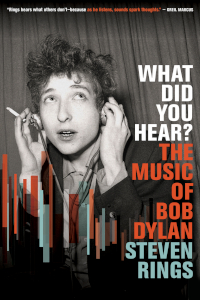
WHAT DID YOU HEAR? The Music of Bob Dylan. By Steven Rings. Chicago and London: University of Chicago, 2025. 360 pp. 5 halftones, 61 line drawings, 1 table. $29.95
One of the many subplots to the career of Bob Dylan has been the amount of literature his work has generated. As he currently plows his way around Europe in his 84th year, presses worldwide show no letup in their zeal to put “original” material before us. New or newish this month, for example: The Poetry of Bob Dylan; After the Flood: Inside Bob Dylan’s Memory Palace; My Greenwich Village: Dave, Bob, and Me; Bob Dylan Outside the Law: The Poetics of John Wesley Harding; and Bob Dylan: Prophet Without God. Now, without in any way wishing to cast judgment on titles I have not read, I’d say this is a fairly typical crop: a discourse on the lyrics; a quasi-biography; a memoir; the academic application of literary theory; and something on Dylan’s societal impact. There is in truth, though, a difficulty which often occurs once one starts reading a new Dylan-related title, the feeling of being dropped into a furrow which has already been very extensively plowed. If you have read Christopher Ricks’s Dylan’s Visions of Sin, or Greil Marcus’s Invisible Republic, for example, you may feel that other books on the lyrics or the “Basement Tapes” aren’t going to give you much, and so it frequently proves to be.
Surprisingly, however, until now there has been precious little of interest to read about Dylan’s music. Despite the industry which has grown up around the lyrics, which Dylan’s Nobel Prize for Literature only catalyzed further, the extant writing on his music has tended to be both amateurish in its analysis and stylistically poor. These two characteristics are related. If you’re not musically trained, you’re inevitably going to thrash about trying to define something you don’t really have the tools to describe. And even if you are a musician, well, writing about music is hard. Step up Steven Rings, Associate Professor of Music and the Humanities at the University of Chicago. Now hold on. I know what you might be thinking: that there are PhD’s to be written (haha) on the academicization of Dylan and attendant incoherence. But Rings is impressively a world apart from my implied caricature. If you want an example of someone who is steeped in their subject and invested in it, who can communicate and who has insights aplenty, in short someone who wears their considerable learning lightly, Rings is your man. He has written a brilliant book.
I want to enumerate four aspects which make What Did You Hear? such an exciting and groundbreaking experience. First, clarity of structure. In the first two thirds of the book Rings takes us through aspects of Dylan’s music via its creation and realization instrumentally. The first part consists of five chapters on “Voicing.” There are fascinating things covered here: Dylan’s vocal technique, especially his famously unpredictable and “incessantly” syncopated singing, which set him apart early on from the folk tradition; the different singing voices and identities he has adopted, put aside, returned to; his ability to become the protagonist of the songs he is singing, vividly demonstrated in an analytical tour de force examining Dylan’s early recording of “House of the Rising Sun”; and, what some might regard as the elephant in the room, an exploration of how Dylan has traversed what Rings describes as “the continuum between speech and song” throughout his career. The second part of the book looks at the instruments Dylan plays, starting with a chapter on the guitar, which looks at both technique and genre in what to me was a wholly revelatory way. Then we have the harmonica. Nobody has written so well on this before, I think. Rings demonstrates that what makes Dylan’s harmonica special has less to do with technique—indeed in technical terms there might not be much to write home about at all—but more the “speechlike” eloquence he is able to effect and the consonant emotional expression achieved. His chapter on the piano is my favorite of the three. It’s become an increasingly important instrument to Dylan over the last 25 years, ironically, since over that time his technique, never solid to start with, has splintered somewhat. The touching final section of the chapter, on the musical relationship between Dylan and the pedal steel player Donnie Herron, and how the latter’s “crucial connective tissue” has been pivotal to how we’ve heard and received Dylan’s piano playing over a long period, is just riveting.
One might think that pretty much covers everything. Certainly as a reader, my mind was buzzing restlessly already by this stage, but what comes next is simply superb: a chance to revisit many of the aspects previously discussed in the book in a bravura four-chapter exploration of the song “Hard Rain.” We see Dylan right at the start of the book typing the “long poem” which will be the lyrics of the song, and in the third section, Rings picks up the story. In two chapters he talks about how Dylan made the song sound the way it did in the studio in 1962. He examines its melodic origins in Woody Guthrie’s and Dylan’s own performances of Guthrie’s song “1913 Massacre” and Dylan’s “Song to Woody,” as well as Dylan’s use of his “prematurely aged” voice and the elements of the guitar part. Then the final two chapters discuss how the song has developed in performance. The pivotal moment in this history are the performances that Dylan gave in Nara, Japan in May 1994, when he was supported by a full orchestra, the first and only time this has happened. If you think the idea of Dylan singing anything, let alone “Hard Rain,” with orchestral accompaniment sounds tacky, then the reality as captured on video is confounding—we witness an astonishing all-around achievement. Rings goes on to show how that interpretation was to shape Dylan’s performances since 1978 up to its surprise return—after a gap of eight years—on the “Outlaw” tour in the summer of 2024, an absolutely fascinating journey.
The other aspects of the book’s strengths I can take more quickly. So, second, I want to highlight Rings’s ear and eye for detail and the less than obvious demonstration of a musical characteristic. For example, I didn’t expect the chapter on the harmonica to start with Dylan in Prague in 1995 picking up a harmonica wrongly tuned for the key the band was playing in (ouch!), but it makes the author’s point, as I’ve discussed above. Similarly enlightening but equally unexpected is Rings’s choice of Dylan’s 1970 recording of “Blue Moon” from Self Portrait, leading to an engrossing discussion on what the author calls, channeling Harold Bloom, the “Lucretian swerve” and Dylan’s voice. Or how about commenting on the noodling Dylan is doing in the interstices of Pennebaker’s film Don’t Look Back? (Spoiler: it’s the ascending chord progression that he was to use for “Like a Rolling Stone.”) Finally, although the Nara performance of “Hard Rain” is not at all obscure, having the vision and analytical skills to see its potential as the basis for a narrative of Dylan’s musical development is unquestionably highly insightful.
The third strength is the book’s accessibility. I can’t praise Rings and his publisher, the University of Chicago Press, highly enough for the care and trouble that has been taken here. I came to this book directly after reading Music’s Odyssey, a book published this fall about the history of Western classical music, no less, by the composer and academic Robin Holloway. It’s a very impressive achievement, but in a book of over 1,000 pages there is not a single musical example. This makes things hard for the reader on occasion, especially if using it for reference purposes. In What Did You Hear?, not only are there meticulous notated musical examples, many of them specially transcribed, but each chapter has a set of links to musical and video examples. It’s just fantastic being able to go instantly in the eBook version to the precise example Rings wants us to hear and see. I can’t begin to imagine how long it must have taken to create this resource, but it’s an exemplary service to provide readers.
Finally, I should point out what a gifted writer Rings is. I suspect many Fanfare readers have trudged through texts which have been informative but which have not been permeated with memorable writing. (In fact, many books on Dylan are sadly both uninformative and/or unoriginal, as I implied at the start of this piece, and badly written.) That’s not so here. Rings writes with real flair. I’ve had to be very disciplined not to make this piece a collage of quotations from the book, and should say that I’ve not enjoyed writing on music as much since the last time I last read Richard Taruskin. Rings has none of the latter’s grumpiness but shares with him a command of language and a rare eloquence, even when writing about the technical aspects of music.
So what does the book feel like to read? It’s difficult to give anything like an accurate feel for the sheer rush of insights one receives on almost every page, but here are some completely random examples on “Current Issues in Dylanology” (yes, my new journal is launching soon) to try and at least give you an inkling for the scope. Voicing: Dylan’s mode of delivery which often falls somewhere between speech and song is often generally and lazily characterized by writers as Sprechstimme or Sprechgesang (talk about a little learning being a dangerous thing). Rings explains the technique and its origins with Schoenberg, shows very precise examples of where Dylan uses it, and then, going with a polite precision to the problem with a lot of writing, concludes, “there is no obvious lineage from Schoenberg to him, nor should we rush to create one, in a search for high-cultural prestige.” Thank you.
Playing: is Dylan a “good” piano player or not? Well, not exactly, but … Rings shows how despite a “shaky” technique or in fact perhaps because of it, great performances can emerge. His example of “Time Passes Slowly” from New Morning is illuminating and fun. Here, Dylan’s landing of the 3/4 downbeat a quarter note and a half early at the end of Verse 1 is a clear fluff (actually so counterintuitive that it’s quite difficult to play purposely; you can have a go though, thanks to the transcription provided) but his “ta-da” recovery (also notated) has such wit to it that it’s not difficult to see why this version of the song, replete with other similar “potholes” in the piano playing, was chosen for the album.
Tradition and derivation: anyone with a passing acquaintance with Dylan will tell you that the exclusion of “Blind Wille McTell” from Infidels was a baffling decision even by Dylan’s standards—it’s arguably one of his greatest songs. Rings explores its musical origins in the standard “St. James Infirmary” and in particular the version recorded by Louis Armstrong in 1928. He shows clearly how two crucial differences from the Armstrong original contribute to the striking impact of Dylan’s song. First, the key. Rings recounts how Dylan searched for what felt right. He tried first a slightly higher key than Armstrong before settling on something slightly lower. That lower key is E-flat Minor, a daunting key for amateur classical pianists with its six flats but playing “by ear” simply means you spend your time on the piano’s black keys. Dylan is on record as saying that music played on the black keys sounds “deeper” and there’s no denying the “dark cloud” as Rings describes it, evoked by the key, which pervades the song. Then there is the rhythm. Unsurprisingly Armstrong’s version of “St. James Infirmary” has swung eighth notes (that is, the pulse is unevenly divided between the notes, alternating between long and short). In “Blind Wille McTell” Dylan eschews swung rhythm altogether, presumably thinking it too frivolous for what is a profoundly serious song. Both of these choices are fundamental to the version Dylan and Mark Knopfler recorded, eventually issued on the first of Dylan’s “Bootleg Series,” whose dark and sparse sound is measured by what Rings memorably describes as “ticking straight time [which] suggests a supra-human time scale, a historical process stepping inexorably forward, leaving suffering in its wake.”
These examples are a fraction of a fraction of the enthralling and entertaining discernment which runs through the book. By now I hope I’ve given a flavor of it to the highly enlightened corpus of Fanfare readers who are interested in Dylan, so I had better stop. Let me end at the beginning, as it were. Rings prefaces the book with a lovely epigraph taken from Wallace Stevens’s “The Poems of Our Climate” which ends “…delight,/Since the imperfect is so hot in us,/Lies in flawed words and stubborn sounds.” It’s this apparent imperfection, Rings suggests, which is the key to what makes Dylan’s music memorable, and truly great: a thesis he advances with extraordinary insight and elegance to make this the best book on music of any genre I have read for a very long time. Dominic Hartley